

The short answer
Start with one verse that is short enough to repeat and meaningful enough to carry. Read it in a trustworthy translation, read the surrounding passage, and notice who is speaking and what problem or hope is present. Then hide the text and retrieve it. The moment of effort matters: you are training your memory to find the words, not merely recognising them on a page.
Check your wording against the Bible after each attempt. Correct one phrase at a time and try again. A brief review tomorrow is more useful than an hour of cramming today. Add prayer so the verse remains connected to God and its context, rather than becoming a password or a performance.
Why memorize Scripture at all?
The psalmist writes, "I have hidden your word in my heart, that I might not sin against you." (Psalm 119:11, WEB). The image is not a trophy shelf of perfect recitations. It is a word carried inward, available when a printed Bible is not in reach. Paul also calls Christians to let the word of Christ dwell richly among them (Colossians 3:16). Read both passages in context; memorization supports discipleship, but it does not replace understanding, worship, community or wise counsel.
What learning science says: retrieval and spacing
Two findings from cognitive psychology translate especially well to Scripture memory. Retrieval practice means trying to produce an answer before looking at it. In a 2006 study, Roediger and Karpicke found that students who practised recalling a text remembered more a week later than students who only reread it. The uncomfortable effort is part of the learning, even when the first attempt is incomplete.
Spaced practice means distributing reviews over time. Cepeda and colleagues’ 2006 review of verbal recall research found that spreading practice generally supports longer-term retention better than putting the same work into one sitting. Dunlosky and colleagues later rated practice testing and distributed practice among the more effective general learning techniques. These studies were not Bible-specific and they do not guarantee that a particular verse will be remembered in seven days. The schedule below is a practical adaptation, not a tested Bible-memorization protocol.
You can use both ideas with paper. Cover the verse, say it, uncover it, correct it and wait before the next review. Recognition feels smooth because the answer is visible; recall feels harder because your mind must retrieve it. That difficulty is useful. Keep the goal modest: accurate, meaningful recall that you revisit over time.
The 7-day method for one verse
Choose one verse of one or two sentences. Short is good. Read the wider paragraph before you begin, write down the reference and decide which translation you will keep for this verse. This seven-day rhythm is a gentle starting point. If a day does not work, continue the next day without trying to punish yourself with extra study.
| Day | What to do | Time |
|---|---|---|
| 1 | Read three times slowly, note the reference and context, then cover it and try to say it. Check and correct; repeat three to five times. | 5–10 min |
| 2 | Recall before looking. Check the wording and say it three times from memory. | 3 min |
| 3 | Recall once in the morning and once in the evening. Notice where you hesitate. | 2 × 1 min |
| 4 | Write the verse from memory by hand and check every word against the source. | 3 min |
| 5 | Pray the verse. Respond in your own words and keep the biblical meaning in view. | 3 min |
| 6 | Recall only. If you stumble, use the first-letter cue below, then try without it. | 1–2 min |
| 7 | Say it to a friend or record yourself. Check accuracy, then choose whether to begin another verse. | 2 min |
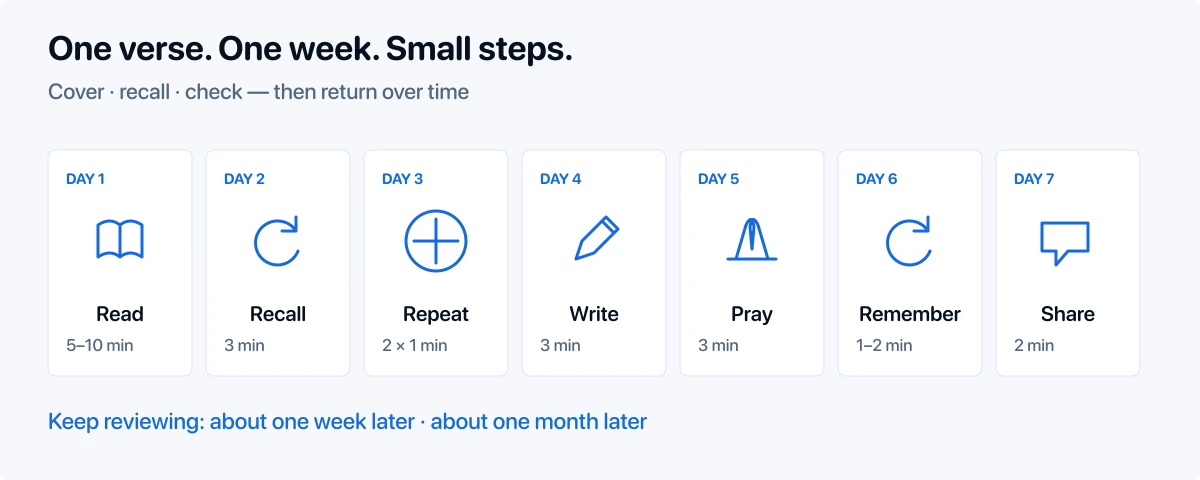
After day seven, review once after about a week and again after about a month. Then keep it in a small rotating list if it remains important. The time labels are approximate prompts, not a promise of mastery. Your schedule, verse length, translation and prior familiarity all affect the experience.
Five techniques that help verses stick
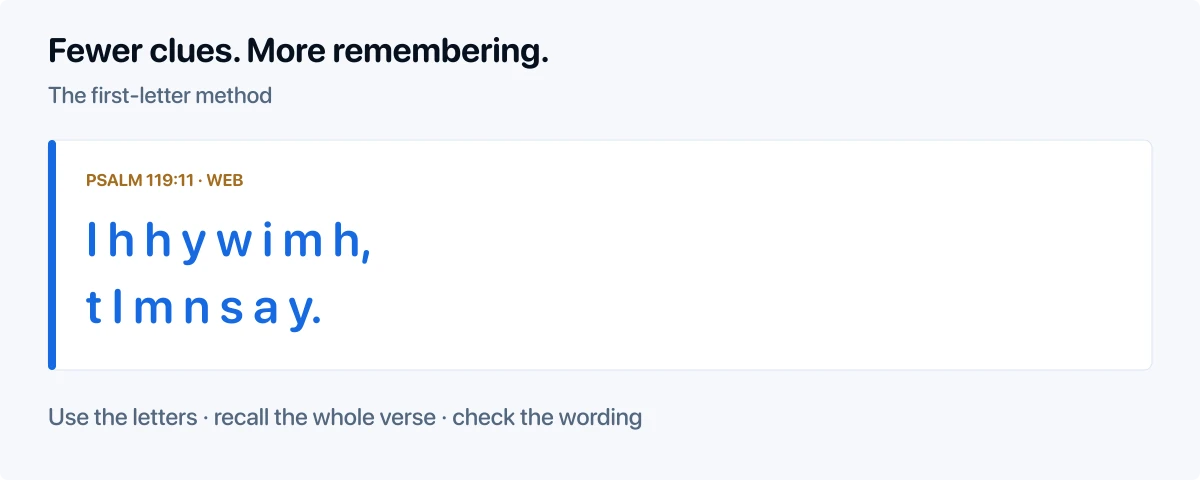
First-letter method
Write only the first letter of each word: I h h y w i m h, t I m n s a y. This is the exact first-letter cue for Psalm 119:11 in the WEB: “I have hidden your word in my heart, that I might not sin against you.” Looking at the letters gives just enough help without displaying the answer. Gradually remove the cue. It is a bridge to retrieval, not a replacement for knowing the words.
Write it by hand
Writing slows your eyes and makes you notice small words, punctuation and the reference. Use an index card, notebook or a note beside your coffee maker. Write from memory first, then compare with the source. Copying can help you become familiar with the shape of a sentence, but the important step is still closing the book and producing it yourself.
Say it out loud—and pray it
Speaking gives the words sound and rhythm. Say the verse naturally, then pause and ask what it invites you to bring to God. Turn it into a short prayer in your own words without pretending that your paraphrase is the Bible’s wording. Memorization and interpretation are different: first learn what the text says, then consider what it means in context, and then respond in prayer.
Chunk longer passages
For Psalm 23, a paragraph from Philippians or another longer passage, learn one manageable unit at a time. Recite from the beginning before adding the next unit. Mark natural phrases rather than cutting through a sentence. If the passage is emotionally difficult or confusing, slow down and ask a trusted pastor, teacher or mature Christian for help. Knowing words perfectly does not settle every interpretive question.
Attach it to a daily cue
Habits become easier to remember when they follow something already in your day: brushing your teeth, making coffee, starting the car or unlocking your phone. Use the cue as an invitation, not a test. Take ten seconds, recall the verse and then continue. You can also keep a card where you normally wait. For a visible phone reminder, see how to put a Bible verse on your iPhone Lock Screen.
Review schedule
| When | Review |
|---|---|
| Same day | Several short recalls after reading and correcting. |
| Next day | Recall before looking at the text. |
| Days 3–7 | One or two brief recalls each day. |
| After about one week | One unprompted recall. |
| After about one month | One recall and a wording check. |
| After that | Every few months or in a rotating review list. |
Turn phone moments into Scripture moments
Many people unlock a phone automatically. That moment can become a cue for a ten-second recall before a feed or message. You do not need to make the phone bad or refuse every use. Ask what you came to do, recall the verse and choose deliberately. If you still need the app, open it for that reason. If you do not, place the phone down.
For more practical quiet-time ideas, read short Bible passages for a five-minute quiet time and Bible verses about phone distraction and self-control. For a slower way to read and pray through a passage, try Lectio Divina. These are complementary practices: memorization helps recall, while prayerful reading helps you attend to a passage as a whole.
12 starter verses about attention and focus
Read each passage in context and use the translation you intend to memorize. The one-line notes below are helpful paraphrases, not additional literal quotations.
- Psalm 119:11 — Hide God’s word in your heart as a response to temptation.
- Psalm 46:10 — In upheaval, remember God’s presence and sovereignty.
- Psalm 90:12 — Ask for wisdom to notice and use your limited days.
- Proverbs 4:23 — Guard the inner life because it shapes how you live.
- Isaiah 26:3 — Trust in God as a path toward steady peace.
- Matthew 6:33 — Let God’s kingdom and righteousness take first place.
- Romans 12:2 — Let renewed thinking reshape how you discern what is good.
- 1 Corinthians 10:31 — Eat, drink and act with God’s glory in view.
- Philippians 4:8 — Direct attention toward what is true, honourable and worthy.
- Colossians 3:2 — Set your mind on things above while living faithfully here.
- Hebrews 12:1–2 — Lay aside what entangles and look to Jesus with endurance.
- 1 Peter 5:7 — Bring your anxieties to God because he cares for you.
Psalm numbering can differ between traditions and translations. In the WEB, “Be still, and know that I am God” is Psalm 46:10; in Luther 1912, the corresponding numbering is Psalm 46:11. Check the heading and wording in your chosen Bible rather than mixing systems.
When you forget (you will)
Forgetting is part of learning. The effort of remembering again is exactly why a later recall can strengthen the memory. When a verse slips, look at it once, close the text and try again. If you have missed several days, resume today. The same gentle restart applies when you are behind on your Bible reading plan. Do not add shame or an unrealistic catch-up session. A review list should serve your life, prayer and relationships, not become another source of pressure.
It also helps to distinguish accurate memory from a comforting interpretation. A verse can encourage you without meaning that every outcome will be easy or immediate. Read the paragraph, notice its audience and genre, and ask questions when the application is unclear. Scripture memory is a way of carrying a text; it is not permission to use an isolated sentence against yourself or someone else.
How Pray Shield fits in
Pray Shield: Christian Focus uses Apple’s Screen Time to place a short pause with a Bible verse and prayer before the distracting apps you select. Choosing which apps to pause is free. Bible and prayer features are available in the optional Plus subscription. The app provides a cue for attention and prayer. Keep your chosen memory verse on paper or in a separate note; this practice does not depend on creating learning verses inside Pray Shield.
Use the pause simply: recall this week’s verse, take one honest breath and decide what you meant to do. Get Pray Shield on the App Store.
Frequently asked questions
What is the fastest way to memorize a Bible verse?
Choose a short verse, understand its context, cover it and retrieve it, then review it over several days. Rereading alone can feel fluent without building reliable recall.
How long does it take to memorize a Bible verse?
Some people can recite a short verse after several focused sessions over about a week, while others need longer. Long-term retention requires later reviews; the schedule is not a guarantee.
Which Bible translation should I memorize?
Use one you read regularly and understand, and keep that translation for the verse so you do not blend different wordings.
How many verses should I memorize at once?
One new verse per week is a sustainable starting point. Keep older verses in a small rotating review list.
Can I memorize Scripture if I have a bad memory?
Yes. Start with a short verse, use first-letter cues, retrieve rather than only reread and be patient with yourself.
Should children memorize Bible verses differently?
Songs, motions and family repetition can help. Make Scripture part of ordinary life rather than turning memorization into a test.