


The short answer
Lectio Divina means “divine reading”. It is not a race through a reading plan or a test of how much background you can remember. You take a short biblical passage, read it with care, listen for what draws your attention, and answer God in prayer. The familiar pattern has four movements: lectio (read), meditatio (reflect), oratio (respond) and contemplatio (rest).
For a first practice, choose five to ten verses and set aside fifteen minutes. Read the passage more than once. A phrase may stay with you, or nothing may seem especially striking. Either response is fine. The purpose is a patient encounter with Scripture, not a dramatic feeling or a perfect result.
What Lectio Divina is and where it comes from
Slow, prayerful reading has been part of Christian spiritual life for many centuries. It became especially associated with monastic communities, where Scripture was read aloud and returned to throughout the day. In the twelfth century, the Carthusian prior Guigo II described a four-rung ladder of reading, meditation, prayer and contemplation. That image is helpful, as long as the steps remain a guide rather than a performance.
Today, people practise Lectio Divina in Catholic, Orthodox and Protestant contexts, in private prayer, families and small groups. The language and order may vary, but the centre remains the same: receiving a biblical text attentively and answering God honestly. It is not a substitute for studying context, learning from a church community or listening to wise teachers. Study asks what a passage means in its setting; Lectio Divina gives that meaning time to become prayer.
Read the whole passage and keep its context in view. A sentence that comforts you should not be turned into a promise that ignores grief, injustice or the rest of Scripture. If a text is confusing or troubling, it is appropriate to pause, consult a trusted commentary or talk with a pastor, priest or mature Christian.
Why slow reading matters in a scrolling world
Much phone reading is designed for quick decisions: a headline, a notification, another item in an endless feed. It is easy to carry that pace into Bible reading and look for one useful sentence before moving on. Lectio Divina gives you permission to stay with a small passage. You may read the same line three times and still have more to notice: its picture, its tension, the person speaking, or the desire it awakens in you.
This is not a claim that phones are bad or that every reading must be long. It is an invitation to choose the pace that suits prayer. You can read from a printed Bible, a screen or an audio Bible, then put the device aside. The practice is measured by attention and openness, not by the number of pages completed.
The four steps of Lectio Divina
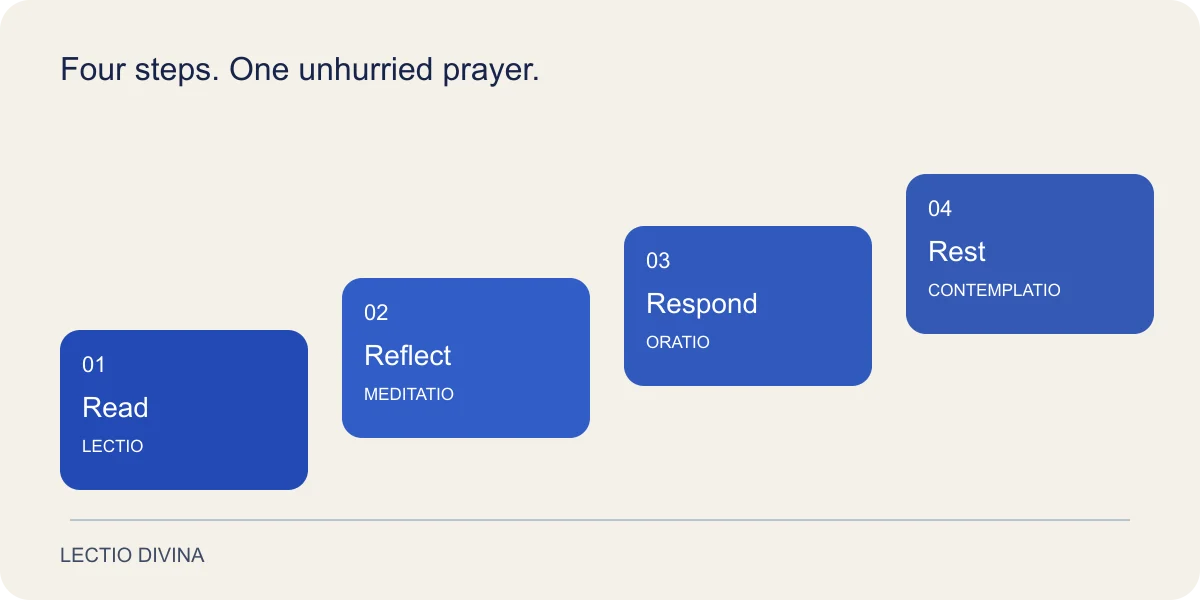
1. Lectio — read
Choose a short passage and settle your body. Read it slowly, aloud if that helps. Read it a second time without trying to solve it. Notice a word, image or sentence that seems to invite your attention. You do not have to explain why it matters yet. Write the phrase down if you need to, then read once more.
2. Meditatio — reflect
Stay with the phrase that caught your attention. Repeat it quietly or let it sit in your mind. Ask simple questions: What is happening in this passage? What does this word show me about God, my neighbour or myself? Where does it meet my life today? Let the questions open prayer; do not force a clever interpretation.
3. Oratio — respond
Speak to God about what you have noticed. You might give thanks, ask for help, confess something, express sorrow or say that you do not understand. Use the passage as a starting point, but use your own words. A prayer as short as “Lord, teach me to receive this” is enough. Honest prayer includes difficult emotions; you do not need to make yourself sound calm or certain.
4. Contemplatio — rest
Stop adding words for a while. Sit quietly before God and receive the moment. Thoughts will wander. When you notice, return gently to the phrase or to the awareness that you are with God. Do not measure the silence by how empty your mind becomes. If silence feels uncomfortable, begin with a brief pause and end with a simple thank-you.
Some teachers add actio, a concrete response. It can be as ordinary as apologising, asking someone how they are, refusing an impulsive message or carrying one sentence into a difficult conversation. Action does not earn anything; it is a way to let prayer become visible.
A 15-minute Lectio Divina routine
| Minutes and movement | What to do | A gentle question |
|---|---|---|
| 0–1 · Beginning | Settle, breathe naturally and ask God for attention. | What do I need to release before I read? |
| 1–4 · Reading | Read the passage twice, slowly and aloud if possible. | What word or image draws me? |
| 4–7 · Reflecting | Read again and stay with one phrase. | Where does this meet my life today? |
| 7–10 · Responding | Speak or write an honest prayer. | What do I want to say to God? |
| 10–14 · Resting | Remain quiet; return gently when distracted. | Can I receive this moment without producing? |
| 14–15 · Closing | Choose one small response and end with thanks. | How might I carry this into the next thing? |
The timings are a simple shape, not a rule. You can shorten a movement or stay longer with a difficult prayer. If you only have a few minutes, read one paragraph, speak one sentence to God and pause before returning to your day.
Good passages to start with
Choose a passage short enough to read repeatedly and rich enough to invite questions. A psalm gives you language for praise, fear and trust. A Gospel scene lets you watch how Jesus meets a person. A letter can help you pray through a virtue or a struggle. Try Psalm 23, Psalm 46, Psalm 119:105, Matthew 11:28–30, Luke 10:38–42, John 15:1–11, Philippians 4:4–9 or Romans 12:1–2.
The phrases in this article are paraphrases unless they are explicitly identified as quotations. Read the referenced passage in a Bible and let the surrounding verses guide you. For example, Psalm 46 invites stillness in the context of God’s presence amid upheaval; it is not a guarantee that your circumstances will immediately become quiet.
If you follow a reading plan, take one manageable paragraph from today’s reading. If you have fallen behind, you can start with a fresh short passage rather than trying to repay a backlog. The Bible reading plan guide can help you return with less pressure: start a Bible reading plan again.
Doing Lectio Divina with a phone nearby
A phone can be the place where you read Scripture and the object that interrupts you. Decide which role it will have before you begin. Turn on Focus or Do Not Disturb for the practice, open the passage first, and place the phone face down when you move into reflection and prayer. Paper notes can keep you from switching to another app. A printed Bible is also a good choice.
Choose a repeatable moment: before opening an app in the morning, at lunch, or before bed. If you need your phone for the passage, make the next action obvious: one translation, one bookmark, no open feed. Our guide to reading the Bible on your phone without distraction offers more practical setup ideas. For a shorter beginning, try these short Bible passages for five-minute quiet time.
Common struggles and gentle responses
- “Nothing stands out.” That is a normal session. Choose one sentence, read the passage once more and remain available without demanding an insight.
- “My mind keeps wandering.” Notice the thought and return without scolding yourself. The guide on praying when your mind wanders gives this practice more room.
- “I do not know what to say.” Repeat one phrase as a prayer, or tell God exactly that you have no words. Silence can be an honest response.
- “The passage brings up pain.” Do not force a comforting conclusion. Stop, name what is happening and seek support from a trusted person if needed. Prayer can accompany care from a pastor, counsellor or doctor.
- “I fall asleep.” Change posture or time of day, and keep the practice brief. Rest is not moral failure.
- “I am turning it into homework.” Remove the pressure to complete every step. One attentive reading and one honest prayer are already a faithful beginning.
Silence feels awkward. Start with one minute. You may keep your eyes open and return to the passage without trying to manufacture a special experience. Christian meditation means dwelling on Scripture; Lectio Divina includes that reflection and also an explicit response to God in prayer. Different meditation practices have different aims, so their shared quietness does not make them interchangeable.
Lectio Divina in a group or family
Choose a short passage and explain that sharing is voluntary. One person reads it, the group keeps a quiet pause, and the passage is read again. Participants can share a word that stayed with them, then a sentence about why it matters, without correcting or debating one another. A final round can be a short prayer. A leader should protect privacy and make room for people who prefer silence.
With children, use a few verses or a brief story. Invite them to name a picture or favourite word rather than asking for a polished interpretation. A family can read before a meal or at bedtime, with one minute of quiet and a simple prayer each person chooses. The aim is shared attention, not a new demand on an already full evening.
How Pray Shield fits in
Pray Shield: Christian Focus uses Apple’s Screen Time to place a short pause with a Bible verse and prayer before the distracting apps you choose. Choosing apps is free. Bible and prayer functions are available in the optional Plus subscription. The pause can become a small Lectio moment: read the verse slowly, notice one phrase, pray one sentence and then decide whether opening the app serves what you meant to do.
Pray Shield does not replace a Bible, church, pastoral care or professional support. It is simply a prompt at a familiar moment. Get Pray Shield on the App Store.
The biblical language in this guide is paraphrased unless explicitly marked as a quotation. Scripture references are invitations to read the full passages in context.
Keep a verse as a visible reminder: put a Bible verse on your iPhone Lock Screen.
Frequently asked questions
What are the four steps of Lectio Divina?
Lectio means read, meditatio means reflect, oratio means respond in prayer, and contemplatio means rest quietly in God's presence. Some traditions add actio, a practical response.
How long should Lectio Divina take?
There is no required duration. A fifteen-minute routine is a helpful starting point, but a shorter attentive practice is also valid.
Which Bible passages are best for Lectio Divina?
Short psalms, Gospel scenes and compact sections of the letters work well. Psalm 23, Psalm 46, Matthew 11:28–30 and John 15:1–11 are approachable places to begin.
Can Protestants practise Lectio Divina?
Yes. Although it has monastic roots, Christians in Catholic, Orthodox and Protestant traditions use slow, prayerful reading of Scripture.
Can I do Lectio Divina on my phone?
Yes. Open the passage first, silence interruptions and put the phone down during reflection when possible. A printed Bible or audio reading works too.