


The short answer
Choose a start date, an end date and a small set of rules. You might pause every social feed while keeping direct messages needed for family, work or care. Write down why you are doing it, tell one trusted person and decide what you will do in the minutes that normally disappear into scrolling. Then add friction: log out, move apps away from the home screen, silence notifications and use Screen Time if it helps. During the fast, notice your urges without turning them into a moral scorecard. When it ends, return slowly and write rules that protect the attention you recovered.
Fasting in Scripture is not a way to make God owe us an outcome. It is a way of turning toward God with our whole attention. Jesus says that people do not live by bread alone (Matthew 4:4, paraphrased). A social media fast is a voluntary modern practice inspired by that posture; it is not a biblical command, and it is not the same thing as the food fasts described in Scripture. Your health, work, caregiving and relationships matter. Adapt the plan with wisdom.
Why consider a social media fast?
Spiritual reasons
- Make room for stillness. Psalm 46:10 (WEB) invites us to be still and know that God is God. A quiet interval can make room for prayer, though it cannot manufacture a particular spiritual experience.
- Notice what has power over you. Paul writes that things may be lawful without being allowed to master us (1 Corinthians 6:12, WEB). A fast tests whether an app serves you or rules you.
- Guard your attention. Philippians 4:8 names what is true, honourable, just, pure and lovely as worthy of thought. A feed is not designed to make that discernment for you.
- Bring comparison into the light. If scrolling leaves you envious, restless or dissatisfied, a pause can help you name that pattern and respond with prayer, gratitude or conversation. See social media comparison and Christian contentment.
What research suggests
A 2022 University of Bath randomized study of 154 adults compared a one-week social media break with continued use. The break group reported improvements in well-being and symptoms of depression and anxiety over that short period. A 2018 University of Pennsylvania study of 143 undergraduates asked participants to limit Facebook, Instagram and Snapchat to about 10 minutes per platform per day for three weeks; the limited-use group reported less loneliness and depression. These studies had specific participants, measures and time periods. They do not show that social media harms every person, that a fast cures depression or anxiety, or that a spiritual plan is validated. If you are struggling with your mental health, seek professional and pastoral support; a fast is not a substitute for care.
Before you start: five decisions
- Your why. Finish: “I am fasting from social media to…” Keep it concrete: pray with less distraction, be present with family, interrupt comparison or recover an evening.
- What is in and out. List every app. You can pause feeds while keeping direct messages, accessibility tools, work communication or emergency contact. There is no prize for making responsibilities impossible.
- How long. Seven days is a manageable first experiment. Thirty days gives more time to observe patterns and practise a different rhythm. Put both dates on a calendar.
- Who knows. Tell a friend, spouse, small group or colleague how to reach you and why you may be quiet.
- What replaces it. Decide what happens in the first five minutes of a morning, commute, break and evening. A vacuum invites the old habit back.
Set up your phone
Willpower is weakest when you are tired or bored. Move social apps to the last Home Screen, log out where practical, remove non-person notifications and charge your phone outside the bedroom. Apple’s Screen Time can limit or block selected apps; see how to block social media without deleting it. Keep a paper Bible, notebook or book where the phone normally sits. If your work or safety depends on an app, use a narrower rule.

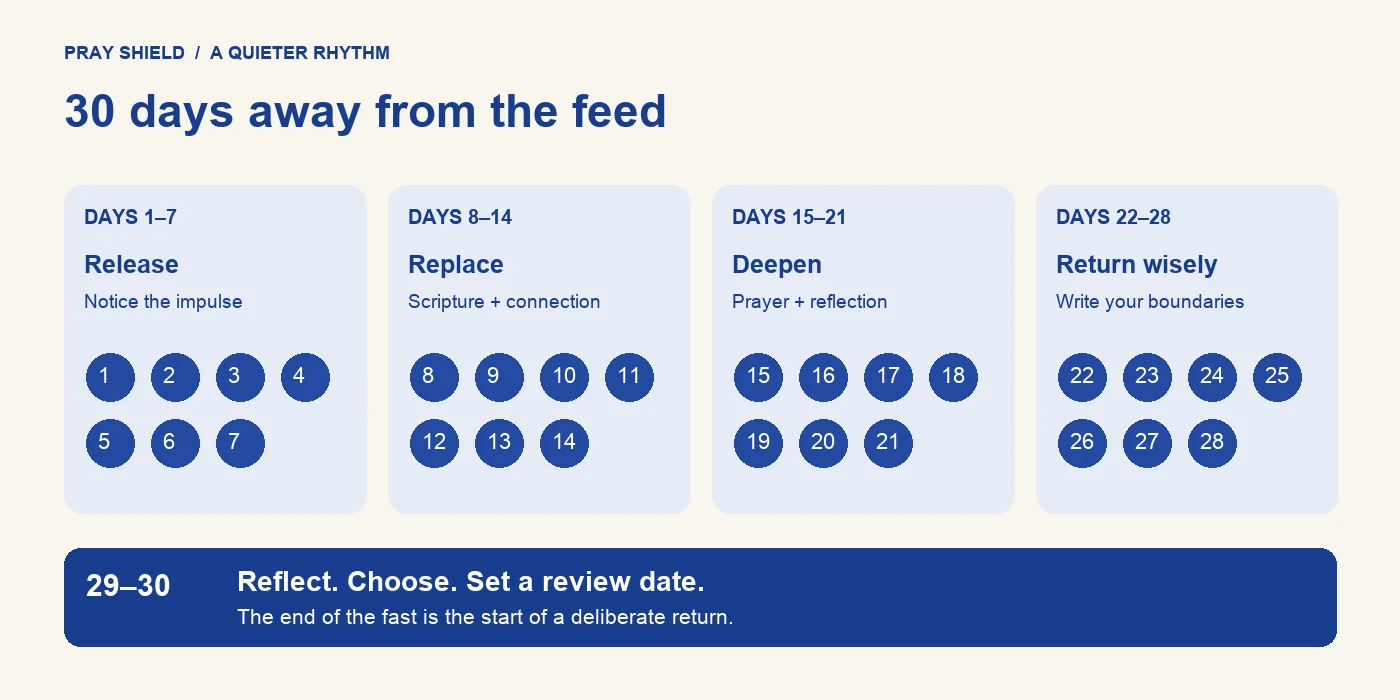
A complete 30-day social media fast
Use each prompt lightly. Five focused minutes is enough. If a day is not possible, continue the next day; do not turn the plan into a second source of pressure.
| Day | Practice |
|---|---|
| 1 | Write your why, dates and included apps. |
| 2 | Log out, move apps and silence non-person notifications. |
| 3 | Notice every urge; note time, place and feeling. |
| 4 | Pray one sentence when you reach for a feed. |
| 5 | Take one screen-free walk or meal. |
| 6 | Read a short Psalm before your first optional screen. |
| 7 | Review what was difficult, peaceful or surprising. |
| 8 | Choose one replacement for your common scroll time. |
| 9 | Call or meet one person instead of checking updates. |
| 10 | Write three ordinary gifts for which you are grateful. |
| 11 | Pray for someone you would normally watch online. |
| 12 | Read Philippians 4:8 in context and name one boundary. |
| 13 | Leave the phone in another room for one hour. |
| 14 | Ask someone trusted what they notice about your presence. |
| 15 | Take ten minutes of silence without forcing an answer. |
| 16 | Journal one comparison trigger and a truthful response. |
| 17 | Do one practical act of service. |
| 18 | Read a Gospel paragraph slowly and pray from it. |
| 19 | Protect the first 30 minutes after waking. |
| 20 | Protect the last 30 minutes before sleep. |
| 21 | Review three weeks and adjust one replacement. |
| 22 | List accounts you will not bring back. |
| 23 | Draft rules for messages, news and work use. |
| 24 | Try one planned screen-free weekly rest period. |
| 25 | Write what you want your attention to serve next month. |
| 26 | Choose the few apps, if any, that may return. |
| 27 | Set fixed times, limits and a no-bed rule. |
| 28 | Tell your accountability person the re-entry plan. |
| 29 | Re-read your why and record what you are keeping. |
| 30 | Decide whether to return, extend or repeat a shorter fast; write rules before opening a feed. |
The seven-day version
Days 1–2 define the rule and notice urges. Days 3–5 replace scrolling with prayer, Scripture, people, movement or rest. Days 6–7 are for reflection and re-entry boundaries. A seven-day fast is complete even if it feels ordinary; you are learning your pattern, not earning a spiritual score.
Exceptions and real life
Keep emergency communication, caregiving, accessibility, work or study obligations as needed. If your job requires social platforms, fast from recommendations and nonessential browsing instead of all access. If you are travelling, grieving, isolated or responsible for someone vulnerable, choose a shorter daily window or one app. If avoiding all social contact would increase loneliness, replace feeds with direct human contact and speak with someone you trust. This digital practice does not advise changing food or medication.
If you slip
Opening an app automatically is information, not proof of failure. Close it, take one breath, name what you needed and continue. If the same moment keeps catching you, add a barrier there: sign out, hand the phone to someone for an hour or change the rule. If a full fast is not serving your responsibilities or well-being, narrow it. Grace is part of Christian practice; a fast should turn you toward God and love of neighbour, not shame.
Coming back without old habits
Bring back one app at a time, at a planned time and place. Keep mornings and the bed screen-free. Unfollow or mute accounts that reliably produce envy or agitation. Set a daily limit, disable autoplay where possible and keep direct messages separate from the feed. Review the rule after one week. You might keep one day offline each week or one week each season; see a Christian digital Sabbath and the Advent digital fast. If you return and immediately lose control, pause again and ask for support rather than escalating self-criticism.
What to do with the time
Make the replacement as concrete as the boundary. In the morning, place an open Bible beside your cup and read a short psalm before any optional screen. During a break, step outside or pray in your own words: “God, help me be present here.” In the evening, reach for a book, call a friend, take a walk or simply rest. Not every recovered minute needs to become another productive task.
Match the replacement to the need. If you scroll because you are lonely, arrange a real conversation. If you are tired, choose rest. If you are avoiding a difficult task, write down its smallest next step. Ask what you wanted the feed to provide and choose a response that serves that need.
A concrete first week back
On the first day after the fast, restore one app for one clear purpose, such as replying to a friend. Choose a short window after work before you open it. The number of minutes is your practical choice, not a scientifically established ideal. Keep notifications off and your phone charging outside the bedroom.
After three days, ask whether you are opening deliberately or automatically again. After seven days, review your boundaries with the person who supported you. Adjust one rule at a time. You may leave an app off permanently or extend the break; finishing a fast does not require restoring every previous habit.
Checklist
- My purpose and dates are written down.
- I listed what stays available and what pauses.
- A trusted person knows the plan.
- Notifications, Home Screen and Screen Time are prepared.
- I have morning, break and evening replacements.
- I know how exceptions will work.
- I wrote re-entry rules before day 30.
How Pray Shield can help
Pray Shield uses Apple’s Screen Time to put a short pause before the apps you choose. Instead of opening straight into the feed, you see a Bible verse and a prayer first—a moment to decide whether you really want to go in. Choosing which apps to shield is free; the Bible and prayer features are part of the optional Plus subscription. It works well during a fast, and afterwards when you want to keep the space you made.
Frequently asked questions
Is a social media fast biblical?
Fasting to seek God is biblical; a social media fast is a voluntary modern application, not a command or proof of greater faith.
Should I choose seven or thirty days?
Seven days is a manageable first experiment. Thirty days gives more time to observe patterns and practise a new rhythm.
Can I keep messaging apps?
Many people keep direct messages needed for family, care or work while pausing algorithmic feeds. Define the exception before starting.
What if I open an app by habit?
Close it, pray briefly, notice the trigger and continue. Add a barrier if the same moment repeats.
What should replace scrolling?
Prepare specific options such as Scripture, prayer, a walk, a call, rest, reading or service.
How do I avoid old habits afterwards?
Bring apps back one at a time, use fixed times and limits, protect mornings and bedtime, and curate your follows.